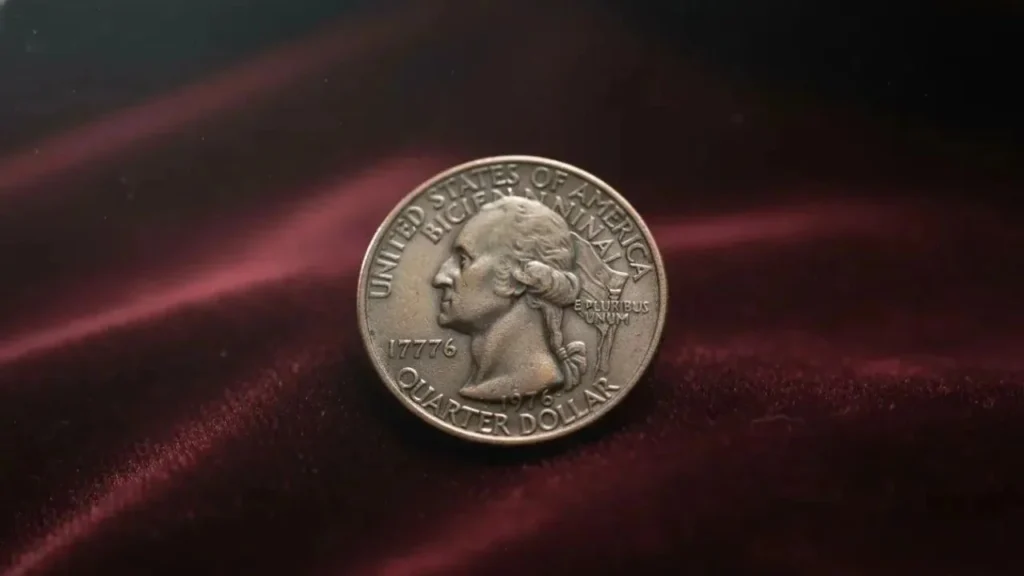

That old quarter sitting in your drawer could be worth a small fortune. Discover which 1976 Bicentennial quarters are fetching up to $2,000 in today’s collector market.
Quick Value Guide: 1976 Bicentennial Quarters
| Quarter Type | Mint Location | Key Features | Current Value 2026 |
|---|---|---|---|
| Philadelphia (No Mint Mark) | Philadelphia | Common circulation, premium for MS67+ | $0.25 – $200+ |
| Denver (D Mint) | Denver | Stronger strikes, error varieties | $0.25 – $250+ |
| San Francisco Clad Proof (S) | San Francisco | Mirror finish, collector quality | $5 – $500+ |
| San Francisco 40% Silver (S) | San Francisco | Silver content, rare high grades | $50 – $2,000+ |
The Story Behind America’s Bicentennial Quarter
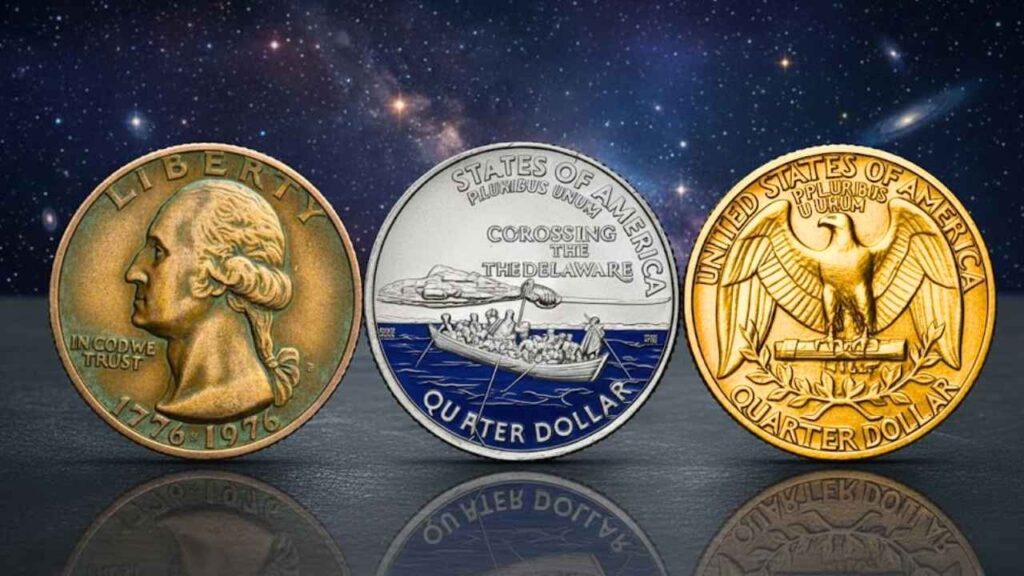
In 1976, the United States celebrated 200 years of independence with a bold move redesigning the quarter for the first time in decades. The U.S. Mint unveiled a special commemorative coin featuring the dual date “1776-1976” and a striking colonial drummer boy on the reverse, surrounded by thirteen stars representing the original colonies.
Millions of Americans saved these quarters as patriotic souvenirs, thinking they’d all become valuable someday. Here’s the truth: most are still worth just 25 cents, but certain rare varieties are now commanding serious money in the collector market.
As we approach America’s 250th anniversary in 2026, interest in these historic coins has skyrocketed. Collectors and investors are hunting through old coin jars, inherited collections, and bank rolls searching for the hidden gems worth hundreds or even thousands of dollars.
Read this: Top Valuable Quarter Dollar Coins Worth Big Money in 2026
4 Rare Bicentennial Quarters Worth Serious Money
1. Philadelphia No Mint Mark Quarter: The Common Coin with Uncommon Value
What Makes It Special: The Philadelphia Mint cranked out over 809 million Bicentennial quarters without any mint mark. While this sounds like too many to be valuable, condition is everything.
Value Potential:
- Circulated condition: Face value (25 cents)
- Uncirculated (MS63-65): $3 – $15
- High grade (MS67): $150 – $200
- Exceptional (MS68): $500+
What to Look For: Sharp, well-defined details on the drummer boy’s face and drum, clean fields without scratches or wear, and original mint luster. The highest-grade examples show no contact marks and appear as if they just left the mint yesterday.
Collector Tip: Check old mint sets and bank-wrapped rolls from 1976. Many people saved these thinking they’d appreciate, then forgot about them for 50 years.
2. Denver Mint Quarter (D): The Error Hunter’s Dream
Identification: Look for a small “D” mint mark on the obverse (front), just above the date on the right side.
Why Collectors Want Them: Denver produced about 860 million Bicentennial quarters, but this mint is famous for interesting errors and varieties. The Denver facility often produced coins with doubled dies, off-center strikes, and other minting anomalies that drive collectors wild.
Value Breakdown:
- Standard circulated: 25 cents
- Uncirculated (MS65): $5 – $12
- High grade (MS67): $200 – $250
- Error varieties: $50 – $1,000+
Famous Errors to Hunt:
- Doubled Die Obverse: Look for doubling on “LIBERTY” or the date
- Doubled Die Reverse: Check the drummer’s outline and stars
- Off-Center Strikes: Partial design visible, rest blank
- Weak Strikes: Missing details that create unique varieties
2026 Market Update: With the rise of social media coin communities, error coins are getting discovered and authenticated faster than ever, driving prices up 30-40% in the past two years.
3. San Francisco Clad Proof Quarter (S): The Collector’s Choice
What Is a Proof Coin? Proof coins aren’t meant for circulation. They’re specially made for collectors using polished dies and planchets, struck multiple times to create extraordinary detail and a mirror-like finish.
Recognition Features:
- Deep, mirror-like fields that reflect light
- Frosted, raised designs that contrast beautifully with mirrored backgrounds
- Sharp, crisp details far superior to regular strikes
- “S” mint mark indicating San Francisco production
Packaging: These quarters were sold in special proof sets by the U.S. Mint in 1975-1976. If you find one in original government packaging, even better.
Current Market Values:
- Standard proof (PR65-67): $5 – $15
- High grade (PR69): $50 – $150
- Perfect (PR70): $300 – $500+
Investment Angle: PR70 specimens have appreciated 200% since 2020. As fewer perfect examples remain available, prices continue climbing.
4. San Francisco 40% Silver Quarter (S): The Hidden Treasure
The Silver Story: While most Bicentennial quarters are copper-nickel clad, the San Francisco Mint produced a special version containing 40% silver specifically for collector sets. These were never intended for circulation, making any found “in the wild” particularly exciting.
How to Identify Silver Quarters:
- Check the Edge: Silver quarters have a solid silver edge. Clad quarters show a copper stripe in the middle.
- Look for the “S” Mint Mark: All 40% silver Bicentennial quarters have an “S” mint mark.
- Weight Test: Silver quarters weigh 5.75 grams vs. 5.67 grams for clad versions (requires precision scale).
- Sound Test: Silver quarters produce a higher-pitched “ring” when dropped on a hard surface.
Why They’re Valuable:
Beyond collector demand, these quarters have intrinsic precious metal value. At current silver prices (January 2026), the melt value alone is approximately $2.50-3.00 per coin.
Value Guide 2026:
- Average condition: $8 – $15
- Uncirculated (MS65): $25 – $50
- High grade (MS67): $200 – $500
- Exceptional (MS68+): $1,000 – $2,000+
Record Sale: An MS69 40% silver Bicentennial quarter sold for $19,200 in a 2019 Heritage Auction, showing the extreme high-end potential.
How to Identify Valuable Bicentennial Quarters: Expert Guide
Step 1: Check the Mint Mark
- No mint mark = Philadelphia
- “D” = Denver
- “S” = San Francisco (proof or silver)
Location: Just above the date on the right side of the coin’s obverse.
Step 2: Determine Composition
- Clad (standard): Copper-nickel sandwich with copper core visible on edge
- Silver (rare): Solid silver appearance on edge, “S” mint mark
Step 3: Assess Condition
Coin grading uses the Sheldon Scale (1-70):
- MS60-62: Uncirculated but with contact marks
- MS63-65: Choice uncirculated, few marks
- MS66-67: Gem uncirculated, excellent eye appeal
- MS68+: Superb gem, near perfect
Step 4: Look for Errors
Common valuable errors:
- Doubled dies (look closely at letters and numbers)
- Off-center strikes
- Wrong planchet errors
- Clipped planchets
- Die cracks and breaks
Step 5: Professional Grading
For potentially valuable coins, submit to:
- PCGS (Professional Coin Grading Service)
- NGC (Numismatic Guaranty Corporation)
Cost: $20-50 per coin for standard service. Worth it for coins potentially valued over $100.
2026 Market Trends: Why Prices Are Rising
Factor 1: America’s 250th Anniversary Approaching
The upcoming Semiquincentennial celebration in 2026 has renewed interest in all American commemorative coins, especially Bicentennial issues.
Factor 2: Generational Wealth Transfer
Baby boomers who saved these coins in 1976 are now downsizing or passing away, flooding the market with estate collections. This creates both supply and discovery opportunities.
Factor 3: Social Media Treasure Hunting
TikTok and YouTube have created millions of new coin hunters checking their change. This increased demand drives prices higher for quality specimens.
Factor 4: Silver Price Volatility
With precious metal uncertainty in 2026, 40% silver quarters have gained attention as affordable silver collectibles with numismatic premium.
Factor 5: Population Reports Tightening
The number of high-grade (MS67+) examples remains extremely limited. As the supply of top-tier coins shrinks, values continue climbing.
Where to Find Valuable Bicentennial Quarters
1. Bank Rolls
Ask your local bank for rolls of quarters. Many still have 1976 quarters in circulation.
2. Coin Star Reject Trays
Check the reject tray at Coin Star machines—silver quarters often get rejected due to different weight.
3. Estate Sales and Auctions
Older Americans who saved these coins are downsizing. Estate sales often have forgotten coin collections.
4. Thrift Stores and Flea Markets
Look for old piggy banks, coin albums, and “junk” coin lots.
5. Family Collections
Check with older relatives who might have saved Bicentennial quarters in 1976.
6. Online Marketplaces
eBay, Heritage Auctions, and specialized numismatic sites offer authenticated coins (but verify authenticity).
Selling Your Bicentennial Quarters: Maximize Your Profit
For Common Circulated Coins
- Spend them (they’re worth face value)
- Trade them at face value with other collectors
For Uncirculated or Error Coins
- Get Professional Grading (MS65+, errors, proofs, silver)
- Sell Through:
- Heritage Auctions (for high-value coins $500+)
- eBay (for $50-500 coins with good photos)
- Local coin dealers (quick cash but lower prices)
- Coin shows (meet serious collectors directly)
Pricing Strategy
- Research recent sales on PCGS CoinFacts
- Check Heritage Auction archives
- Look at completed eBay listings (not active ones)
- Get multiple dealer quotes
High-grade specimens (MS67+), 40% silver versions, and authenticated errors are solid collectibles with appreciation potential. Common circulated examples are better as interesting historical pieces than investments.
Frequently Asked Questions
How much is a 1976 Bicentennial quarter worth?
Most 1976 Bicentennial quarters are worth face value (25 cents). However, rare varieties can be worth anywhere from $5 to over $2,000 depending on mint mark, condition, silver content, and errors.
Which 1976 quarters are valuable?
The most valuable are San Francisco 40% silver quarters in high grades (MS67+), proof versions in PR69-70 condition, error coins like doubled dies, and any Philadelphia or Denver quarters grading MS67 or higher.
How do I know if my Bicentennial quarter is silver?
Check for an “S” mint mark and examine the coin’s edge. Silver quarters have a solid silver edge, while standard clad quarters show a copper stripe in the middle. Silver quarters also weigh slightly more (5.75g vs 5.67g).
What is the rarest Bicentennial quarter?
The 40% silver San Francisco mint quarters in MS68 or higher grades are among the rarest and most valuable, with some selling for over $1,000. Error varieties like major doubled dies are also extremely rare.
Are Bicentennial quarters still being made?
No. Bicentennial quarters were only minted in 1975 and 1976 (both bearing the dual date 1776-1976). Regular Washington quarters resumed in 1977.
Final Verdict: Hidden Treasures in Plain Sight
The 1976 Bicentennial quarter represents a unique intersection of American history, patriotic symbolism, and numismatic value. While most of the billions minted are worth only face value, the hunt for rare varieties, high-grade specimens, and error coins makes this one of the most accessible and exciting areas of coin collecting.
Key Takeaways:
- Check your change for “S” mint marks (potential silver)
- Examine condition carefully (MS67+ = big money)
- Look for errors and doubled dies
- Get valuable coins professionally graded
- Store properly in protective holders
2026 Outlook: As America approaches its 250th anniversary and more collectors enter the hobby through social media, demand for quality Bicentennial quarters continues growing. Whether you’re a casual coin saver or serious numismatist, these quarters offer an affordable entry into collecting American commemorative coinage.
So before you spend that 1976 quarter, take a closer look. You might be holding a piece of American history worth far more than 25 cents.
$2000 Direct Deposit for US Citizens: What December 2025 Could Bring
Disclaimer: Coin values fluctuate based on market conditions, grading standards, and collector demand. Prices mentioned reflect January 2026 market data from major auction houses and dealer listings. Always consult professional grading services (PCGS, NGC) and certified numismatic dealers before making significant purchases or sales. This article is for educational purposes and should not be considered investment advice.