
India’s electric two-wheeler story is moving fast, but it’s far from simple. Charging anxiety, inconsistent infrastructure, and unpredictable daily usage still hold many buyers back. That reality is exactly why the TVS iQube Hybrid Revealed moment matters right now. Instead of forcing a full leap to electric, TVS is offering a smarter middle path.
The iQube Hybrid arrives as a practical answer to everyday urban commuting. It blends electric mobility for daily city rides with petrol support for longer journeys, addressing concerns that many potential EV buyers quietly worry about but rarely see solved.
Why TVS Is Betting on Hybrid Mobility
TVS Motor Company understands that mass EV adoption will not happen overnight. While metros are adding charging points, large parts of urban and semi-urban India still lack reliable access. A hybrid scooter fits neatly into this transition phase, allowing riders to experience electric benefits without sacrificing convenience.
The iQube Hybrid is not positioned as a tech experiment. It targets office commuters, families, and first-time EV buyers who want cleaner transport but still need flexibility. This approach could significantly widen the appeal of electric mobility beyond early adopters.
Electric-First, Petrol-Ready: How the Hybrid System Works
Designed for Daily City Use
At its core, the iQube Hybrid prioritises electric power. Short commutes, school runs, and city errands are handled primarily by the electric motor, delivering silent, smooth, and emission-free riding. This keeps running costs low and reduces dependence on petrol.
Seamless Petrol Assistance When Needed
When battery levels drop or distances stretch beyond typical city limits, the petrol system steps in automatically. The transition is designed to be seamless, requiring no manual input from the rider. This intelligent energy management removes the fear of being stranded, one of the biggest psychological barriers to EV adoption.
This electric-first philosophy aligns with global trends where hybrids act as a stepping stone toward full electrification rather than a compromise.
Tackling Range Anxiety Head-On
Range anxiety remains the biggest reason many buyers hesitate before choosing an electric scooter. The TVS iQube Hybrid addresses this directly by expanding usable range far beyond what a pure EV can offer in real-world conditions.
Riders can rely on electric power for most of their usage while knowing petrol backup is always available. That confidence changes buying behaviour, especially for households that depend on a single two-wheeler for all daily travel.
Familiar Design, Built for Comfort and Trust
A Look That Doesn’t Alienate Buyers
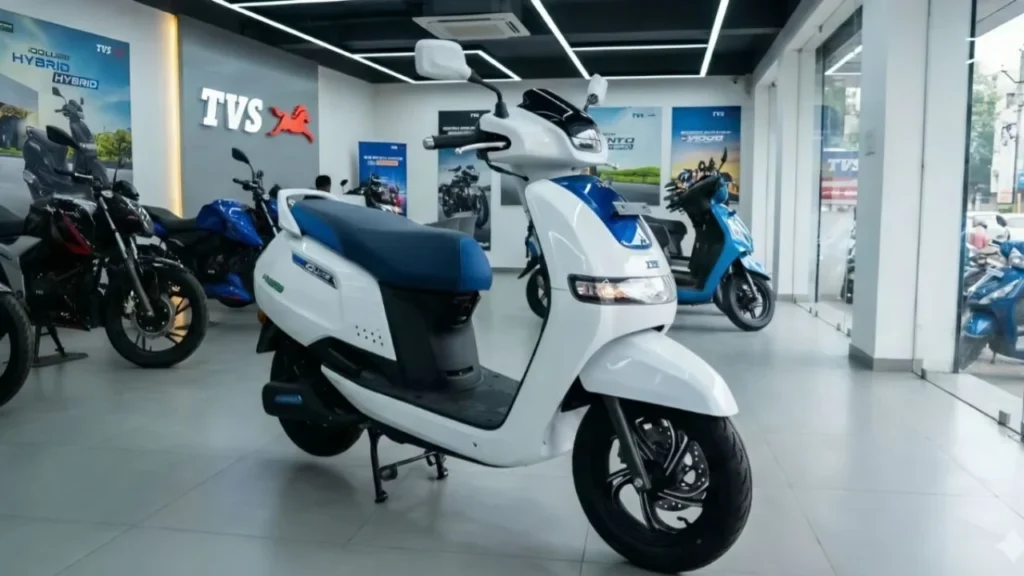
TVS has wisely retained the familiar iQube design language. The styling remains clean, modern, and approachable, avoiding sharp or aggressive elements that could limit its appeal. This continuity helps existing TVS customers transition comfortably to the hybrid model.
The flat floorboard, upright riding posture, and wide seat make it suitable for riders of all ages. Small design changes accommodate hybrid components, but practicality remains the priority.
Smart Tech for Smarter Riding
Connected features have been a strong point of the iQube range, and the hybrid continues that tradition. Expect a fully digital display showing navigation, battery status, fuel levels, and real-time energy flow between electric and petrol systems.
Smartphone connectivity, ride analytics, and efficiency tracking help riders understand how they use power and where they save money. Regenerative braking and intelligent energy management play a key role in improving efficiency during stop-and-go city traffic.
Lower Running Costs Without Lifestyle Compromise
One of the strongest arguments in favour of the iQube Hybrid is cost efficiency. Electric riding drastically reduces fuel consumption, while petrol backup eliminates dependence on charging schedules. Electricity remains far cheaper than petrol, translating into meaningful savings over time.
Maintenance costs are also expected to stay reasonable, as TVS has engineered the system with durability and long-term ownership in mind. For budget-conscious urban households, this balance is likely to be a major selling point.
Pricing Strategy and Market Positioning
TVS is expected to price the iQube Hybrid between standard petrol scooters and premium long-range electric models. While the upfront cost may be higher than a basic petrol scooter, long-term fuel savings and flexibility could offset the difference quickly.
This positions the iQube Hybrid as a value-driven alternative rather than a niche product. It competes not just with EVs, but also with high-mileage petrol scooters that dominate Indian cities today.
Who Should Consider the TVS iQube Hybrid
The hybrid setup makes sense for riders who want lower fuel bills without changing their daily habits. It suits professionals with regular commutes, families relying on a single scooter, and buyers curious about EVs but not ready to commit fully.
In markets where charging infrastructure remains inconsistent, this approach could unlock demand that pure electric scooters struggle to reach.
A Strategic Move in India’s EV Transition
India’s electric mobility push needs solutions that reflect ground realities. The TVS iQube Hybrid acts as a bridge, encouraging gradual adoption rather than forcing abrupt change. From an industry perspective, it could influence other manufacturers to rethink all-or-nothing EV strategies.
By reducing hesitation and building confidence, hybrids like this can quietly accelerate the shift toward cleaner transport.
Final Verdict
The TVS iQube Hybrid Revealed story is less about headline-grabbing technology and more about smart problem-solving. By combining electric efficiency with petrol reliability, TVS has created a scooter that fits how people actually live and commute.
If executed well at launch, the iQube Hybrid could become a defining product in India’s two-wheeler transition, offering a realistic, flexible, and future-ready alternative for urban riders who want cleaner mobility without compromise.